Gypsum board is one of the most useful materials for creating modern interior ceilings, partition walls and smooth wall finishes. It is widely used in residential, commercial and institutional buildings because it is relatively lightweight, easy to work with and suitable for a variety of interior designs.
However, not every gypsum board is designed for the same purpose. A board selected for a bedroom ceiling may not be the best option for a humid room, a fire-rated partition or a space that requires better sound control. Choosing the right specification from the beginning can help you avoid unnecessary repairs, poor finishes and additional construction costs.
At GypsumHub, we recognise the importance of understanding the material before purchasing it. This guide explains what gypsum board is, the different types, common sizes, applications, installation considerations and the factors to evaluate when sourcing gypsum board in Nairobi and elsewhere in Kenya.
What Is Gypsum Board?
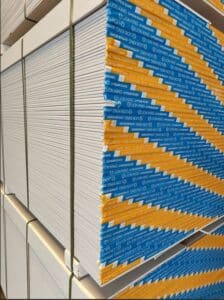 Gypsum board is a manufactured building panel made primarily from a gypsum-based core enclosed between facing materials, commonly paper. Gypsum is a mineral composed of calcium sulphate dihydrate. The finished board is used to create interior wall linings, suspended ceilings, partitions and other building systems.
You may also hear gypsum board referred to as drywall, plasterboard or wallboard. These terms are often used interchangeably, although the exact product specifications and intended applications can vary.
Unlike traditional wet plastering, gypsum board installation generally involves fixing manufactured panels to a suitable supporting framework or, for certain systems, an approved substrate. The joints and fixings are then treated to produce a surface suitable for decoration.
This makes gypsum board useful for projects where a clean interior finish, relatively quick installation and flexibility in room layout are important.
Why is gypsum board used in construction?
Gypsum board offers several practical advantages:
- Smooth interior finishes: Properly installed and finished boards provide a surface suitable for painting and other compatible decorations.
- Flexible interior layouts: Boards can be used to construct non-load-bearing partition walls and divide rooms without building conventional masonry walls.
- Ceiling design options: They support flat ceilings, stepped designs, bulkheads, recessed areas and concealed-lighting details.
- Relatively lightweight construction: Compared with many traditional wall systems, gypsum board partitions can reduce the weight of interior finishes, subject to the complete system design.
- Fire-performance options: Some boards are designed for fire-rated wall and ceiling systems when installed with the specified framework, fixings, joints and other components.
- Specialised performance options: Depending on the product range, boards may be designed for moisture resistance, sound control or particular installation environments.
The benefits depend on the board specification, installation quality and intended application. Standard gypsum board should not automatically be assumed to provide waterproofing, structural support or a particular fire-resistance rating.
Types of Gypsum Board and Their Uses
Understanding the available board types is one of the most important steps when planning a ceiling or partition project. The right choice depends on the room, exposure conditions, performance requirements and installation system.
1. Standard gypsum board
Standard gypsum board is commonly used for general interior applications in dry environments. It is a practical option for many residential and commercial ceiling and partition projects.
Typical applications include:
- Living room ceilings
- Bedroom ceilings
- Interior partition walls
- Office partitions in suitable dry environments
- Wall linings and other approved interior finishes
Standard board is often selected where the main priorities are a smooth finish, straightforward installation and compatibility with ordinary interior decoration.
When selecting it, check the thickness, dimensions, edge type and manufacturer’s recommendations. A board suitable for one ceiling system may not automatically be suitable for another.
2. Moisture-resistant gypsum board
Moisture-resistant gypsum board is manufactured for applications where improved resistance to moisture is needed. Some products have distinctive coloured facings or cores, but colour alone should not be used to identify the board or determine its performance.
Potential applications include certain kitchens, utility rooms, bathrooms and other interior areas where the manufacturer permits its use.
Before choosing a moisture-resistant board, consider the actual conditions in the room. Is the area exposed to occasional humidity, frequent splashing or direct water? These are different conditions and may require different solutions.
Important: Moisture-resistant gypsum board is not necessarily waterproof. It should not be assumed suitable for continuous water exposure, exterior use or a shower enclosure without a system specifically approved for that application. Waterproofing membranes, appropriate detailing, ventilation or an alternative board material may be necessary.
For a room with plumbing or a history of dampness, identify the source of moisture before installing new boards. Covering a leak without fixing it can lead to further damage.
3. Fire-resistant gypsum board
Fire-resistant gypsum board is designed for use in specified fire-protective building systems. Depending on the product, its construction may include additives or reinforcement that help it perform under fire exposure.
It may be specified for certain commercial partitions, service enclosures, corridors, ceilings and other locations where the building design requires tested fire performance.
However, installing a fire-resistant board does not automatically make an entire wall or ceiling fire-rated.
The performance of a fire-resisting assembly can depend on:
- The exact board type and thickness
- The number of board layers
- The supporting framework
- Screw type, spacing and fixing method
- Joint treatment and perimeter detailing
- Insulation and other specified components
- Penetrations for pipes, cables and other services
Where a project requires a particular fire-resistance period, use a tested or approved system that meets the design specification and applicable building requirements. Confirm the documentation rather than relying on a board’s colour or a general product description.
4. Acoustic gypsum board
Acoustic gypsum boards and complete acoustic partition systems are used where sound absorption or sound insulation is an important consideration.
These applications may include meeting rooms, offices, apartments, classrooms, studios and other spaces where noise control or privacy matters.
The term acoustic can refer to different outcomes. Sound absorption reduces sound reflections within a room, while sound insulation reduces sound transmitted from one space to another.
A perforated acoustic ceiling panel may help control reverberation, whereas a sound-insulating partition normally depends on the complete wall construction. Board layers, cavity depth, insulation, framing, airtightness and junction detailing all influence performance.
Therefore, do not assume that every acoustic gypsum board is soundproof. Identify the actual acoustic requirement and select a system with suitable test data.
5. Impact-resistant and specialised gypsum boards
Some manufacturers offer boards designed for more demanding environments, including areas that require greater resistance to impact, abrasion or other specified conditions.
These products may be considered for busy corridors, schools, healthcare facilities, commercial interiors and similar projects, depending on their approved uses.
Availability, composition and performance vary by manufacturer. Confirm the technical datasheet and installation requirements before specifying a specialised product.
Common Gypsum Board Sizes and Thicknesses
Gypsum board is supplied in different sheet dimensions and thicknesses. The appropriate option depends on the intended application, the supporting system, the required performance and the manufacturer’s guidance.
In Kenya, you may encounter boards described in imperial dimensions, metric dimensions or both.
| Specification | What to check |
|---|---|
| Sheet dimensions | Common formats include approximately 4 ft × 8 ft and 1,200 mm × 2,400 mm |
| Thickness | Common options include approximately 9–9.5 mm and 12–12.5 mm, depending on the product |
| Edge profile | Square or tapered edges, according to the finishing system |
| Board type | Standard, moisture-resistant, fire-resistant, acoustic or another specialised product |
| Intended application | Ceiling, wall lining, partition or another approved use |
These are examples of common formats, not a guarantee that every size or thickness is available from every supplier.
How much area does one gypsum board cover?
The coverage depends on the actual sheet dimensions.
For example, a board measuring 1,200 mm × 2,400 mm covers:
1.2 m × 2.4 m = 2.88 m²
A nominal 4 ft × 8 ft board has an area of approximately 2.97 m² when calculated using the exact imperial dimensions.
These formats are similar but not identical. Always use the dimensions of the product you intend to purchase when estimating quantities.
How many gypsum boards do you need?
A preliminary estimate can be calculated by dividing the surface area by the area of one board.
Number of boards = total surface area ÷ area per board
For example, suppose a ceiling measures 20 m² and you are using boards that each cover 2.88 m².
20 ÷ 2.88 = approximately 6.94 boards.
You would therefore need at least 7 boards based on surface area alone. The actual order may require additional sheets because of offcuts, room shape, ceiling details, damage allowance and the direction of installation.
For partitions, calculate the area of each side that will be boarded, unless your estimate already accounts for both sides. Openings, board orientation and the specified installation pattern also affect the quantity.
A measured cutting plan is more reliable than ordering material based only on a rough room measurement.
Where Can Gypsum Board Be Used?
Gypsum board has several applications in interior construction. The best result comes from matching the board and supporting system to the needs of each space.
Gypsum board ceilings
Gypsum board is used to construct flat and decorative ceilings in homes, offices, retail spaces and other buildings.
Depending on the design, a ceiling may incorporate recessed sections, bulkheads, concealed lighting, access panels or other architectural details.
The supporting framework must be appropriate for the ceiling system, board weight and layout. Access to electrical connections, plumbing and other services should also be considered before the ceiling is closed.
For more guidance on material planning, see our article on local logistics for gypsum building materials in Kenya.
Gypsum board partition walls
Gypsum board partitions divide interior spaces and can be used in offices, homes, commercial premises and other suitable buildings.
A typical partition system may include metal studs and tracks, gypsum boards, screws, jointing materials and optional cavity insulation. The exact components depend on the design.
Before installing a partition, consider its height, expected impact, sound-control requirements, fire performance and the items that need to be mounted on it. Heavy cabinets, shelves and equipment may require planned reinforcement or fixings designed for the load.
Gypsum board partitions should not be treated as structural load-bearing walls unless a specifically engineered system has been designed and approved for that purpose.
Learn more in our guide to modern commercial wall partition systems.
Wall linings
Gypsum board can be used to line suitable interior walls, helping create a consistent surface for decoration or accommodate services within a designed cavity.
Surface preparation, moisture conditions and the specified fixing method are important. Not every wall is suitable for direct board fixing, and damp or unstable substrates need to be addressed before installation.
Commercial and institutional interiors
Gypsum board systems are useful in many commercial interiors because they can support room divisions, service enclosures and selected ceiling designs.
Projects with special fire, acoustic, hygiene or impact requirements need careful specification. A standard residential board should not be substituted for a specified commercial system without confirming that the change meets the project’s requirements.
How to Choose the Right Gypsum Board
Selecting gypsum board is not simply a matter of choosing the cheapest sheet. Consider the following factors before placing an order.
1. Identify the application
Decide whether the board is for a ceiling, partition, wall lining or another use. The application influences the required thickness, fixing method and supporting framework.
For ceilings, pay attention to the board’s suitability for the proposed support spacing and ceiling design. For partitions, consider wall height, expected use and whether additional reinforcement is needed.
2. Assess moisture exposure
Establish whether the room is dry, humid, exposed to occasional splashing or subject to direct water exposure.
Use the manufacturer’s recommendations to determine whether a moisture-resistant gypsum board is appropriate. If the application requires waterproofing or continuous water exposure resistance, a different or additional system may be needed.
3. Confirm fire requirements
Where fire performance is required, obtain the relevant specification for the complete assembly. Confirm board layers, framing, joint treatment and all other components.
Do not select a fire-resistant product based only on colour, price or a seller’s general description.
4. Consider sound control
For partitions between offices, apartments or meeting rooms, determine whether the objective is to reduce sound transmission or control reverberation within a room.
The answer affects the board type and the construction of the entire assembly. Insulation, cavity depth, airtightness and connections can be as important as the board itself.
5. Compare product specifications
When comparing suppliers, check that you are comparing equivalent products. Review the manufacturer, board type, thickness, dimensions and technical documentation.
A lower price for a thinner standard board is not necessarily a better deal than a higher price for a specialised board that meets your project requirements.
6. Plan the complete installation system
Gypsum board is only one part of the finished ceiling or partition. Your material list may also need metal studs and tracks, ceiling channels, screws, jointing tape, jointing compound, corner beads, insulation and finishing products.
The exact list depends on the system. Make sure the components are compatible and that the installer follows the relevant instructions.
What Affects the Cost of Gypsum Board in Kenya?
The cost of gypsum board varies by product specification, supplier and purchasing requirements. Prices can change, so a current quotation is more useful than relying on an old price list.
The main factors to consider include:
Board type: Standard, moisture-resistant, fire-resistant, acoustic and other specialised boards may have different prices.
Thickness and dimensions: Different board formats and thicknesses affect the amount of material supplied and the suitability of the product for a particular system.
Manufacturer and product range: Brands and product lines can differ in specifications, certification, availability and pricing.
Quantity required: A small order and a larger project order may have different quotation terms. Confirm any applicable quantity arrangements with the supplier.
Delivery and site access: Transport distance, unloading arrangements, access restrictions and the quantity being delivered may affect the overall procurement cost.
Additional materials: Framing, fixings, jointing materials, insulation and finishing products contribute to the cost of the completed system.
Installation and finishing: Labour, ceiling complexity, wall height, cutting requirements and the desired finish can influence the final project budget.
Should you compare the price per sheet or per square metre?
Both measures are useful, but they answer different questions.
The price per sheet tells you what you will pay for each board. The price per square metre helps you compare boards with different dimensions.
To calculate the board material cost per square metre, divide the price of one sheet by its actual coverage area. This does not include waste, framework, fixings, finishing or labour.
For a more realistic project budget, estimate the total materials required and obtain separate, clearly defined quotations for any delivery, installation or finishing services.
How Is Gypsum Board Installed?
Installation requirements vary by product and system, but a typical framed ceiling or partition project involves several stages.
Step 1: Measure and plan
Measure the ceiling or wall, identify openings and mark the layout. Plan board orientation, joints, framing positions, lighting and service routes before fixing the panels.
Step 2: Install the supporting framework
Fix the specified tracks, studs, channels or other support components. Check alignment, spacing, stability and the correct fixing method.
Ceiling frameworks must be supported from suitable structural elements using an appropriate suspension system. Do not assume that every ceiling can be fixed in the same way.
Step 3: Cut and fix the boards
Measure and cut the sheets carefully. Install them using the specified screws, fixings, board orientation and joint arrangement.
Follow the manufacturer’s recommendations for screw spacing, edge distances, support requirements and joint positioning.
Step 4: Treat the joints
Apply the appropriate jointing tape and compound or other specified finishing system. Correct treatment of joints, corners and fasteners helps create a consistent surface.
Step 5: Prepare the surface for decoration
Allow the specified materials to dry, complete the required finishing and prepare the surface for painting or another compatible finish.
Step 6: Inspect the completed work
Check for visible defects, uneven joints, loose fixings and other installation issues. Confirm that required access panels remain accessible and that penetrations or junctions meet the project specification.
Where fire or acoustic performance is required, inspect the complete installation against the approved system rather than judging the result by appearance alone.
Common Gypsum Board Problems and How to Avoid Them
Cracks along board joints
Cracking can result from movement, unsuitable joint treatment, poor fixing, inadequate support or other installation problems.
Use compatible jointing materials, follow the required fixing pattern and make sure the supporting framework is correctly installed.
Damage caused by moisture
Water leaks, persistent condensation and unsuitable exposure conditions can damage gypsum board.
Resolve leaks and dampness before installation. Select a board suitable for the environment, and use the required waterproofing or alternative construction where necessary.
Uneven ceilings or partitions
Uneven finishes may result from poorly aligned framing, incorrect spacing, inadequate support or inconsistent joint finishing.
Check the framework before boarding and follow the specified installation system throughout the project.
Poor paint finish
Visible joints and fasteners may show through paint if the surface has not been finished adequately. Dust, incomplete drying and unsuitable preparation can also affect the final appearance.
Use the correct finishing products, allow appropriate drying time and prepare the surface according to the product instructions.
Choosing the wrong board for the application
A standard board may not meet the requirements of a humid room, a specified fire-rated assembly or a partition requiring enhanced acoustic performance.
Confirm the purpose of the space and the product specification before purchasing. The right choice at the beginning can reduce the risk of rework later.
Where to Buy Gypsum Board in Kenya
When sourcing gypsum board in Nairobi or elsewhere in Kenya, look for a supplier that can help you identify the appropriate board specification and plan the materials required for your project.
Before making a purchase, confirm:
- The board type, dimensions and thickness
- The manufacturer and relevant technical documentation
- The quantity required for your measurements and cutting plan
- The availability of compatible framing and finishing accessories
- The current price and quotation terms
- Delivery arrangements, site access and unloading requirements
- Any documentation needed for a specified fire or acoustic system
If you are buying for a contractor, a residential renovation or a commercial development, provide the supplier with as much project information as possible. This makes it easier to compare equivalent products and avoid ordering a board that does not meet the specification.
At GypsumHub, we focus on gypsum products and related construction materials for the Kenyan market. Contact our team to confirm the available products, specifications, current prices and suitable arrangements for your project.
Frequently Asked Questions About Gypsum Board
What is gypsum board used for?
Gypsum board is commonly used for interior ceilings, partition walls, wall linings and selected specialised building systems. Its suitability depends on the board specification and the intended environment.
Which gypsum board is best for ceilings?
The best board depends on the ceiling design, support system, required thickness and environmental conditions. Standard gypsum board is commonly used in suitable dry interior areas, while specialised ceilings may require a different specification.
Is gypsum board waterproof?
Standard gypsum board is not waterproof. Moisture-resistant versions offer improved resistance to certain moisture conditions, but they should not automatically be used for continuous water exposure or treated as a substitute for waterproofing.
Is gypsum board fire-resistant?
Gypsum contains chemically bound water, and many gypsum boards provide some inherent fire-related benefits. However, the fire resistance of a building element depends on the specific board and the complete tested or approved assembly. Confirm the required performance for your project.
Does gypsum board reduce noise?
Some gypsum board systems can reduce sound transmission, while acoustic ceiling products may help absorb sound within a room. The result depends on the board, framing, insulation, number of layers, airtightness and installation details. Standard gypsum board alone should not be described as completely soundproof.
What size is a standard gypsum board?
Common formats include approximately 4 ft × 8 ft and 1,200 mm × 2,400 mm. Actual dimensions and available thicknesses vary by manufacturer and product range, so check the product specification before calculating quantities.
How many gypsum boards are required for a room?
Divide the surface area by the coverage of one board to obtain a preliminary estimate. Add an appropriate allowance for cutting, waste and the installation layout. For partitions, remember to calculate both sides where both will be boarded.
What should I buy with gypsum board?
Depending on the project, you may need framing channels or studs, tracks, screws, jointing tape, jointing compound, corner beads, insulation and finishing products. The required materials depend on the ceiling or partition system.
How do I choose between standard and moisture-resistant gypsum board?
Choose according to the room’s exposure conditions and the manufacturer’s guidance. Standard board is suitable for many dry interiors. Moisture-resistant board may be appropriate for certain humid areas, but direct water exposure can require additional waterproofing or a different material.
Where can I get gypsum board in Nairobi?
You can source gypsum board from building-material suppliers serving Nairobi and the wider Kenyan market. Confirm the exact product specification, availability, price and delivery arrangements before placing an order with your chosen supplier.
Choose the Right Gypsum Board for Your Project
A successful gypsum installation begins with selecting a board that matches the space, performance requirements and supporting system. Consider the environment, dimensions, thickness, finishing requirements and total material cost rather than comparing sheets on price alone.
Whether you are planning a ceiling, partition or interior renovation, careful product selection can help you achieve a more suitable and durable finish.
Contact GypsumHub to enquire about gypsum board and related construction materials in Kenya. Confirm your required dimensions, board type and quantity so that you can obtain product information and a quotation appropriate to your project.
Leave a Reply